
Black Feminist Week of Action
Black feminist writers have always imagined, planned, and strategized ways forward. Returning to their texts, their voices, their visions offers us space to be in dialogue across space and time and to be grounded by the blueprints they’ve offered us.
We’ve been forever changed
Audre Lorde’s poetry that created a map home,
the love letters Ntozake Shange wrote when the rainbow wasn’t enuf,
Toni Morrison’s reminder that we are our best thing
Journey with us as we revisit their lives, work and commitments.
Audre Lorde
Audre Lorde is a part of a "continuum of women” and a "concert of voices" within herself. Her fierce voice reminds us to speak, even when our voices trembles. As a Black feminist, lesbian, mother, warrior and poet, Audre’s full legacy has been a guiding light home and an affirmation that we exist.
Born to Caribbean immigrants from Barbados and Carriacou, raised in New York City and the youngest of three daughters - Audre carries inside her the legacy of immigrants, of sisterhood, and of rebelliousness. From a young age, she spoke in poetry, having memorized poems she loved as responses to questions from teachers and peers. She then began writing her own in the eighth grade. And every poem thereafter was a proclamation that our silence could never protect us. “... my poetry comes from the intersection of me and my worlds…” These worlds expanded as she gifted the power of words to students across CUNY (City University of New York) campuses and birthed Black studies programs into existence.
Audre built transformative spaces that centered the brilliance and contributions of women of color. In 1980, with the belief that the most radical and transformative conversations among women often took place at kitchen tables, offering fuel to our stomachs and our souls, Audre along with homegirls, Barbara Smith and Cherríe Moraga co-founded Kitchen Table: Women of Color Press - the first U.S. publisher for women of color. In 1981, Lorde traveled to St. Croix, where she would later spend her last days in radical love with her partner Gloria I. Joseph, to found the Women’s Coalition of St. Croix. This organization set out a bold vision to support sexual abuse and intimate partner violence survivors through sisterhood and a framework of women’s liberation. She believed that “without community, there is certainly no liberation.” Her trip to Berlin sparked an international movement and connected Blackness and womanhood across continents.
Audre’s feminism actively organized for freedom. Using the most intimate parts of her lived experiences, Audre dared to tell stories that push us to consider wholeness - and in doing so, created space for us to do the same.. “Those of us who stand outside the circle of this society’s definition of acceptable women; those of us who have been forged in the crucibles of difference...” Those of us here, know and must always remember that “...the master’s tools will never dismantle the master’s house” Let us be so unacceptable that we are a dangerous force in the face of oppression.
Audre weaves together constellations of anger, love, and the erotic as an affirmation to ourselves, our sisters, and our communities that we have exactly what we need to light the way forward.
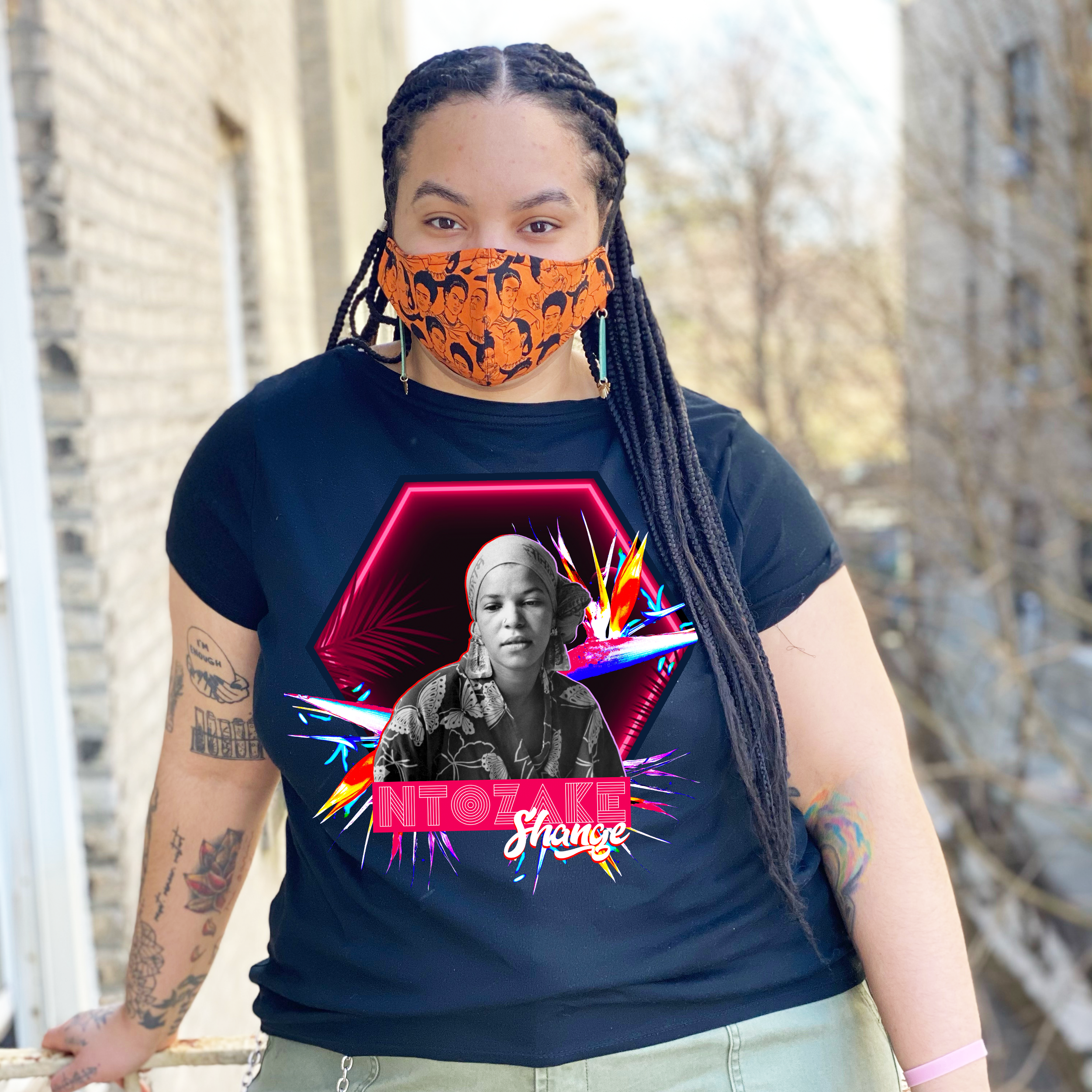
Ntozake Shange
Ntozake:”she who has her own things"
Shange: “she who walks/lives with lions"
The powerhouse playwright, poet, and feminist whose words offer salves of healing. She was always a woman who walked with her own things, reminding us that in our bold expression of ourselves is freedom.
Ntozake created mosaics of poetry through her language, dance, and creative self-expression from a young age. She attended Barnard College graduating in 1970 with an abundance of creative sisters and a commitment to Black feminist principles as embodied in her creative practice. After attending a master’s program at USC, she taught women and Afro-American studies and seeded in young people the space to tell stories in full and deep ways, calling forward the fullest expression of self… “I found god in myself and i loved her i loved her fiercely.”
Ntozake’s works were performed in small underground venues and in large public appearances. Her 1975 coreopoem For Colored Girls Who Have Considered Suicide/When the Rainbow Is Enuf was performed off-Broadway and has been performed across the world, resonating with audiences globally.
As a Black feminist, her work unapologetically addressed power, pain, pleasure, and powerfully centered Black women's stories amidst the backdrop of Black power movements. Her work has created and fueled cultural spaces - from the Nuyorican Poets Café to Shange’s World at Barnard College.
Ntozake’s creativity is revolutionary… and so is yours.
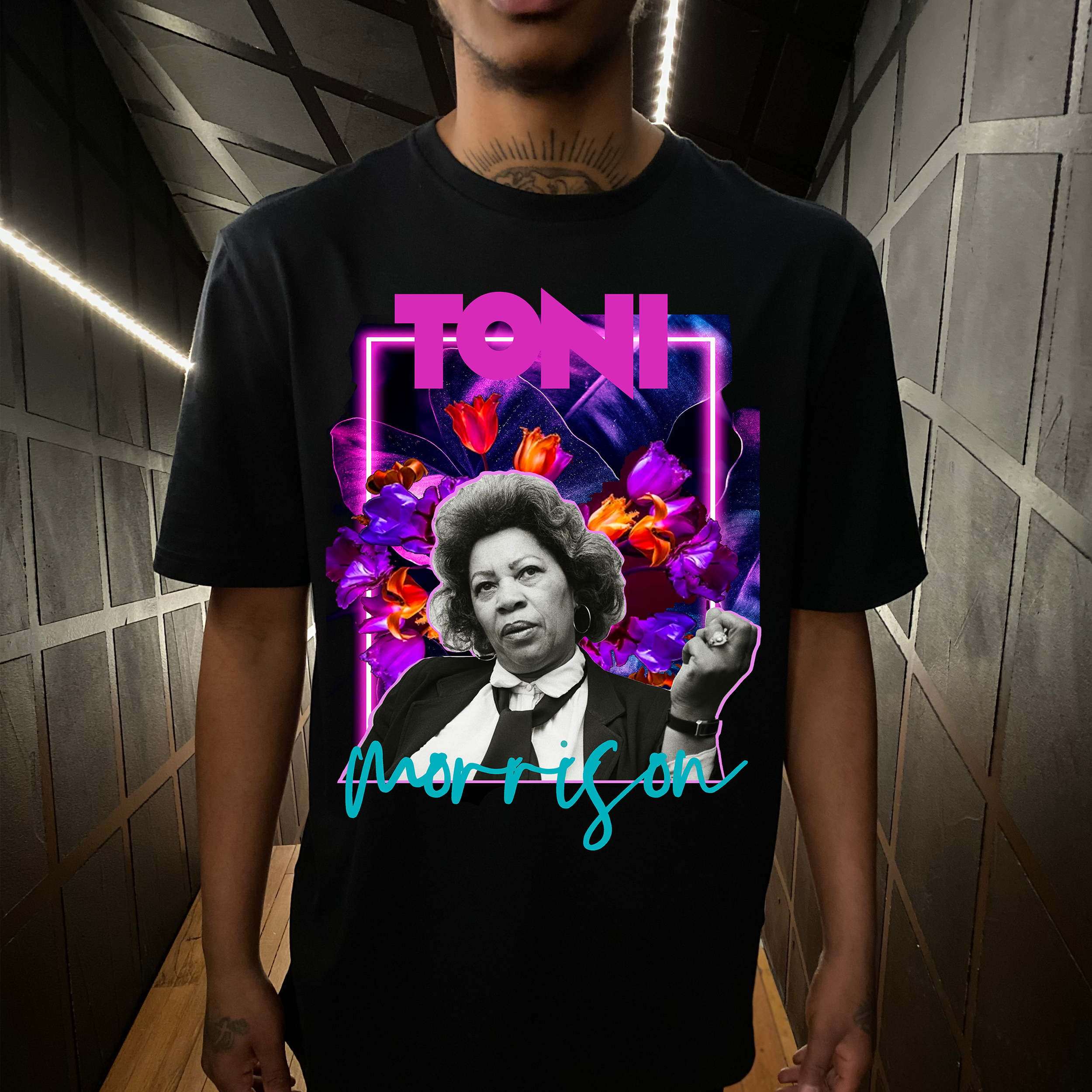
Toni Morrison
Toni Morrison was an educator, novelist, editor and world builder. As a child, Toni loved to read and learned at a very young age that words had power. She worked in her local library and words became a salve and the way she would soothe, heal, and nourish generations. “Word-work is sublime, because it is generative; it makes meaning that secures our difference, our human difference – the way in which we are like no other life.”
Toni majored in English Literature at Howard and joined the university’s theatrical group, the Howard University Players. As a member of the Players, she would learn about and experience segregation in new ways while touring the segregated south. While touring she would steal the “colored” and “white” signs and send them home to her mother, in disbelief of the world she was experiencing.
After Howard, she left DC to attend graduate school at Cornell, which would later secure her a teaching job at Southern Texas University. After a short stint at Southern, she returned to her alma mata Howard University where she would teach students like young civil rights activist Stokely Carmichael. She encouraged her students not to write what they knew but to invent, to write outside themselves.
Toni would leave teaching to go into publishing. She joined Random House at the helm of the Black Power Movement and Women’s Liberation Movement. “It would be my job to publish the voices, the books, the ideas of African Americans and that would last.”
She was responsible for growing, midwiving, and nurturing the works of Black writers and activists such as Toni Cade Bambara, Gayl Jones, Henry Dumas, Angela Davis, Lucielle Clifton, and Muhammad Ali. Her profound contribution to American publishing was to bring Black voices to center stage in a white, male dominated publishing world. Additionally the texts she would publish in the 1960s and 70s served as a bedrock for creating the canon of what we now know as Black Studies. Her 19-year career at Random House made Morrison the first Black woman editor at her level in the company’s history. “I write out of the culture as everyone does, for it, through, it and i'm in it...so a portion of that culture said to me, Amen.”
In addition to supporting the worldbuilding of other Black writers, she was creating works in her own right. She woke up every morning before the sun rose at 5 AM so she could write before her children woke up. Frustrated with every story she had ever read about Black girls, she desired to write a story that framed Black girls in a new light -- that spoke to the interior pain of racism. She wrote novels that placed Black women at the center of epic narratives.
There was freedom in her language and in 1993, Toni Morrison became the first Black woman to win the Nobel Prize in Literature 1993. From 1989 until her retirement in 2006, Morrison held the Robert F. Goheen Chair in the Humanities at Princeton University and was awarded the Presidential Medal of Freedom by President Obama in 2012.
Her work challenged us to be more human, to study and use the power of language, to find and hold onto love after pain, grief, and despair. And for that, “she was loved, and she was loved. And she [is] loved.”
Toni’s voice is revolutionary… and so is yours.

Octavia Butler taught us that if we are meant to survive, we must be willing to expand our wildest imaginations about what is possible. During this time of chaos and uncertainty, we created our Harvest of Survival Affirmation deck - inspired by Black feminist sci fi writers and visionaries. This 25-card affirmation deck is an invitation to pull a card and journal around the prompts. You can do this in solitude or in community.